
Products Description
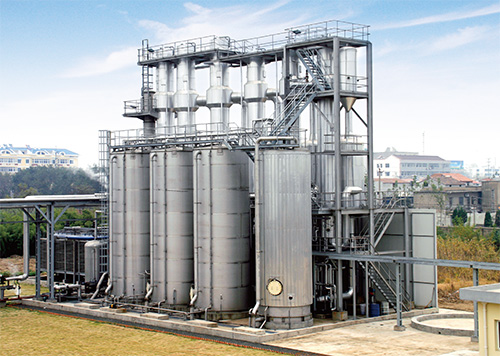
Introduction to Multi effect Falling Film Evaporator
In the falling film evaporation system, the material covers the entire inner wall of the heat exchange tube in the form of a film and flows down the heat exchange tube while evaporating. Even in the case of low evaporation temperature difference, it is still possible to obtain a high heat transfer coefficient. The middle of the heat exchange tube is filled with secondary steam formed by material evaporation. In the design, the secondary steam and material can flow in the same or opposite direction in the heat exchange tube according to the situation. The secondary steam leaving the heat exchange tube then enters the separator to complete the vapor-liquid separation.
The separator can be conventional centrifugal or impact type; It can be designed as a separate type independent of the falling film heater, or as an integrated type with the heater. The integrated design can reduce the footprint and lower installation costs.
Materials with slight scaling issues during evaporation require cyclic evaporation; Even with material circulation, using a falling film design is much more energy-efficient than forced circulation. Thermal sensitive materials can be designed with a direct current falling film to shorten their residence time and reduce the energy consumption of the pump.
The falling film evaporation system is suitable for processing materials without scaling problems or with low scaling coefficients, and is usually not suitable for crystallization. However, based on the characteristics of the evaporated material, two forms of falling film and forced circulation can be combined in the design to handle materials with scaling problems and continuous crystallization systems.
In the design of MVR (mechanical vapor compression) and TVR (steam power heat pump), low evaporation temperature difference can reduce power consumption and steam consumption, and falling film design can be used for situations with low evaporation temperature difference, so it is more suitable for such designs. Due to the influence of the characteristics of the material itself or when low-temperature waste heat evaporation is used (such as tube bundle tail gas or liquefied flash steam), the maximum material temperature in the evaporator is limited. Compared with the rising film design, the falling film design can put in more efficiency to reduce energy consumption. The falling film system is widely used in industries such as food, pharmaceuticals, chemical, paper/pulp, and coal chemical.
Product Features
Due to its high heat transfer coefficient, adaptability to small temperature differences, and high vacuum evaporation characteristics, it can widely utilize low-quality waste heat (such as dryer hot air and flue gas), waste heat (condensate water, process water, and flash steam) to form a waste heat evaporation unit, which can complete concentration tasks with little or no fresh steam, achieving a breakthrough of "zero" steam for evaporation. It has the advantages of high heat transfer efficiency, small temperature difference, no boiling point loss caused by liquid column, and low power consumption.
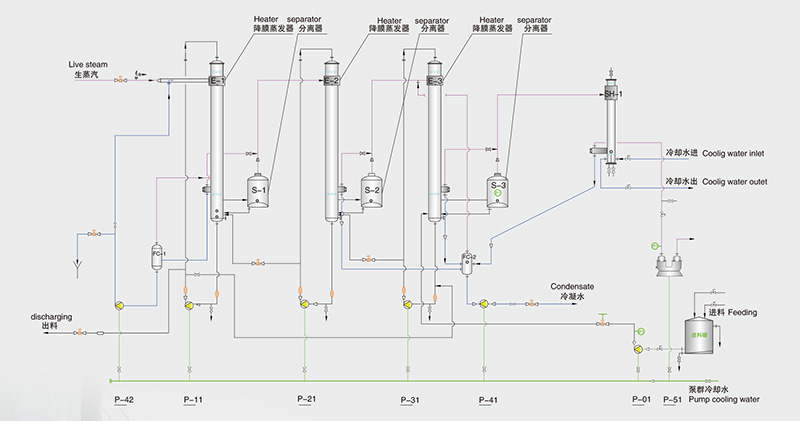
Technological process
Application scope
Multi effect falling film evaporators are widely used for evaporation concentration and crystallization in industries such as starch and derivatives, alcohol, and chemical.