
Products Description
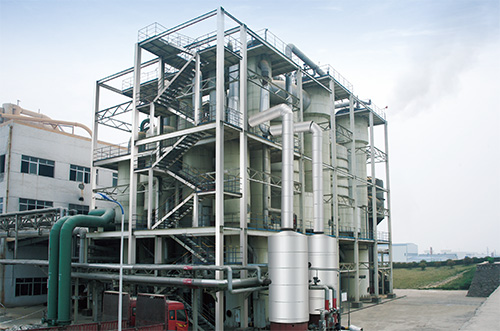
Introduction to forced circulation evaporation/crystallization system
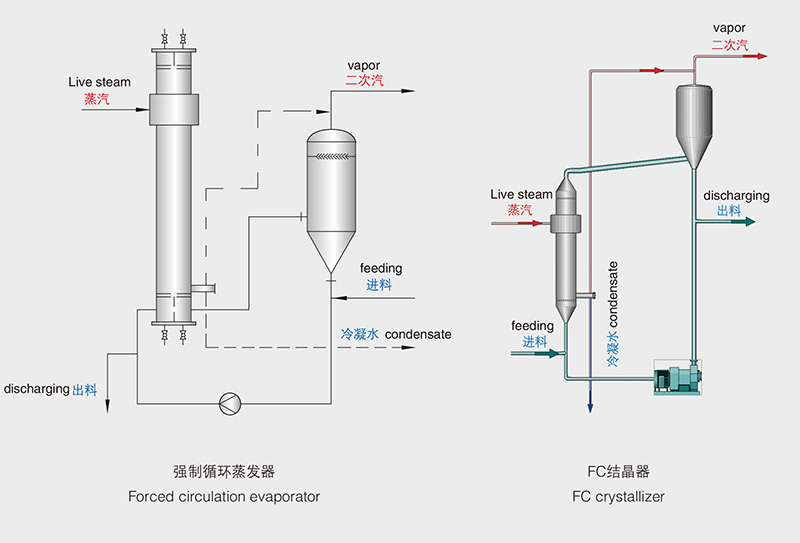
In the forced circulation evaporation system, the material flows through the heat exchange tubes at a speed of 1-3 meters per second through the circulation pump, with a temperature increase of 1-5 ° C. The state of crystal slurry and scaling prone materials in the evaporator heat exchange tube is equivalent to their motion state in pipes of the same size and flow rate, and the impact of small temperature changes is not significant. That is to say, under the same conditions, if the material can pass through a pipeline, it can pass through the heat exchange tubes of the evaporator. The specifications of the circulation pump matched with the forced circulation system are much higher than those of the falling film system; For crystallizers, the required head for the circulation pump is very low. The forced circulation evaporation system has stronger anti scaling ability than the falling film system, and is suitable for the concentration or continuous crystallization of materials that are prone to scaling.
According to the characteristics of the evaporated material, two forms of falling film and forced circulation can be combined in the design to deal with materials with scaling problems and continuous crystallization systems. Pre concentration of the material is completed in the falling film unit, and then it enters the forced circulation unit for final concentration or continuous crystallization, saving equipment investment and operating costs.
Product Features
It has the advantages of a wide range of concentrated materials, high concentration ratio, high discharge concentration, sufficient anti scaling, and anti clogging.
Technological process
Application scope
Typical examples of concentrated use
Corn syrup, alcohol waste liquid, lysine waste liquid, glutamic acid waste liquid, fermentation broth with bacterial cells, yeast waste liquid, penicillin waste liquid, and various types of chemical wastewater.
Typical crystal usage examples
Vc、 Citric acid, lysine, threonine and other amino acids, sodium chloride, ammonium chloride, ammonium sulfate, sodium sulfate, magnesium sulfate, sodium phosphate, sodium carbonate, ammonium carbonate, sodium nitrate, lithium hydroxide, lithium carbonate.